
TG SECURITY | Full Scenario Security Solution Service Provider
JIANGSU TG SECURITY TECHNOLOGY CO.,LIMITED
TG SECURITY
 EN
EN
Quick Links
TG SECURITY | Full Scenario Security Solution Service Provider
JIANGSU TG SECURITY TECHNOLOGY CO.,LIMITED
TG SECURITY
Video has become the core data foundation for security prevention and operational decision-making. But behind the data flood lies a "storage dilemma": research shows that about 70% of surveillance videos are still or low value images, and mixing them with effective content not only wastes storage resources, but also increases the comprehensive cost of hardware procurement and data center operation and maintenance.
As a driving force behind the technological evolution of the security industry, Hikvision has been continuously leading industry innovation for over 20 years with the anchor point of "exploring the core value of videos". The recently released Guanlan coding new technology, with profound insights into the industry and AI driven precise coding logic, breaks the industry curse of "image quality and storage efficiency cannot be achieved at the same time" and provides storage optimization solutions that "reduce costs without reducing efficiency" for thousands of industries.
Technical accumulation: Over 20 years of project practice have honed core competencies
Hikvision's exploration of video value stems from years of technological iteration and project practice:
In 2015, we were the first to integrate deep learning algorithms into front-end devices, ushering in the era of security AI.
In 2017, the AI Cloud three-tier architecture was launched, which solved the pain points of "scattered computing power and insufficient collaboration" and provided strong support for the implementation of AI.
In 2018, an AI open platform was launched to assist zero algorithm based customers in developing exclusive industry algorithms, promoting the deep integration of video perception technology and industrial applications.
In 2021, Hikvision officially invested in the research and development of the Guanlan large model, building a three-level system of "foundation industry task" and consolidating the foundation of video understanding algorithms.
From the basic perception of 'visible' to the precise presentation of 'visible', and then to the deep interpretation of 'understandable', Hikvision's core evolution focuses on five dimensions:
·Upgrade from image structured labels to video deep semantic understanding.
·Iterate from a single scene discriminative model to a visual multimodal large model.
·Shift from distributed computing power on the end side to large-scale computing power deployment on the cloud edge side.
·Expand from recognizing core targets such as people and cars to covering long tail objects across all categories.
·Upgrade from tag based filtering to semantic human-machine multimodal interaction.
For many years, Hikvision has served millions of customers worldwide and has been deeply involved in all scenarios including transportation, finance, industrial parks, and healthcare. It is this technological iteration that originates from practice and is used for practice, laying a solid foundation for the birth of Guanlan coding technology.
Technological Upgrade: AI Empowerment Breaks Bottlenecks
The mainstream traditional encoding technology in the industry can achieve storage optimization of 30%~70% by dynamically adjusting the compression force, but it has obvious limitations: recognition based on the dynamic and static states of objects is prone to misidentifying non critical dynamic objects (such as wind blowing leaves, birds, etc.), and changes in lighting can also affect the effect. It is only suitable for simple static scenes such as warehouses and corridors.
Hikvision's Guanlan encoding technology integrates the deep understanding ability of Guanlan's large model with pixel level segmentation technology to build a full chain optimization system of "intelligent recognition accurate ROI segmentation differentiated encoding", achieving dual collaboration between storage and image quality.
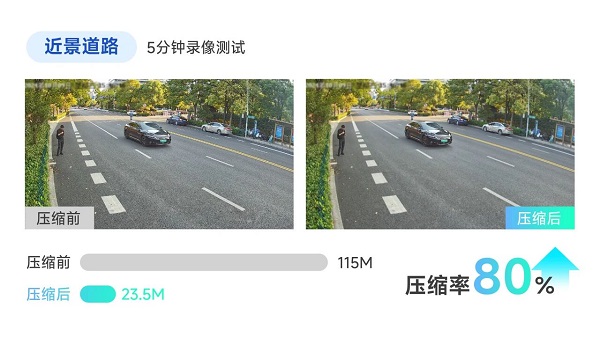
Actual test data: significant improvement in storage efficiency
Big model assistance, digital intelligence upgrade
With the support of our self-developed Guanlan visual model, we can accurately analyze high-value key targets such as people, vehicles, and non motorized vehicles. The recognition accuracy is significantly improved compared to traditional algorithms, and it can support the recognition of up to 64 targets simultaneously.
By using refined ROI protection segmentation technology, the foreground target and background area are accurately separated: the foreground uses conventional encoding to ensure complete details, the background implements efficient compression to reduce storage usage, and finally outputs compliant bitstreams that meet standards, balancing image quality and efficiency. On the premise of ensuring comparable non target quality between humans and machines, the bit rate can be saved by 20% to 90%.
Scene perception, dynamically adapting to the entire scene
Hikvision Guanlan's coding technology is based on "scene perception" and builds a dynamically adapted intelligent coding system, relying on the coordinated operation of dynamic and static perception:
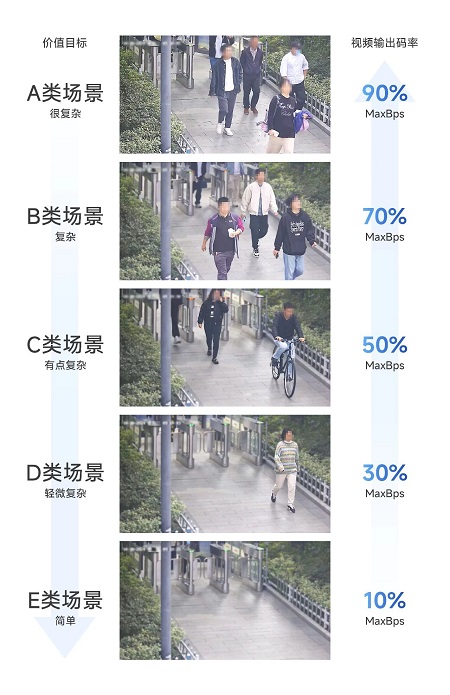
·Dynamic perception: Real time capture of scene motion amplitude and detail density, allocating resources according to the maximum bitrate MaxBps percentage to ensure lossless image quality in complex scenes.
·Static perception: Repeat frame encoding is used for still or low dynamic images, with only a few tens of bytes per frame, maximizing storage cost optimization.
Taking the entrance and exit scenes of the park as an example: high bitrate restoration of details during the morning rush hour, 50% balance of image quality and efficiency at night, and 10% compression in the early morning to maximize storage savings. By dynamically adapting the complexity of the scene, precise allocation of coding resources can be achieved.
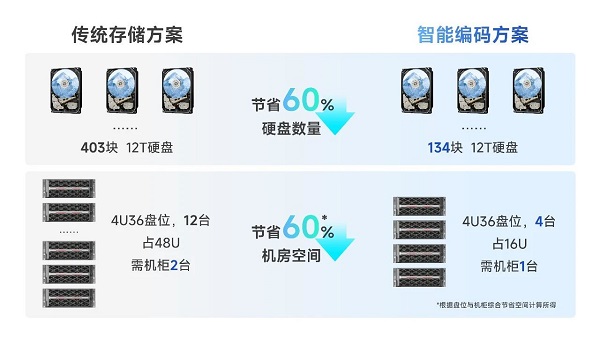
Guanlan encoding, saving money, electricity, and space
With a scale of 2000 routes 1080P@2Mbps Taking 90 day storage as an example, compared to traditional coding, the Guanlan coding scheme achieves a 60% reduction in the number of hard drives, a 60% reduction in data center space, and a 50% reduction in 5-year electricity bills, significantly reducing project costs and truly achieving "cost reduction without efficiency reduction".
From the implementation of deep learning to the application of fully structured data, and then to the release of Guanlan coding technology, Hikvision continues to be committed to "making videos generate greater value" and promoting the evolution of the security industry from "passive recording" to "active intelligence". By deeply integrating AI and coding, video data can be transformed from "massive redundancy" to "precision and efficiency", injecting new momentum into the intelligent upgrading of thousands of industries.
At present, Guanlan coding technology has been applied to the front-end and back-end products of Hikvision and will be released soon. Stay tuned!