
 EN
EN
Why Low Light Surveillance Camera Performance Falls Short in Real-World Environments
Grain, motion blur, and color distortion: The visible symptoms of inadequate low-light design
When ambient light drops below a sensor’s native threshold, signal amplification introduces visible grain—obscuring facial features, license plates, and fine text critical for forensic identification. To compensate for low light, many cameras slow shutter speeds, resulting in motion blur for moving subjects: vehicles, people, or even wind-blown foliage become indistinct. Simultaneously, color fidelity collapses—sensors lose the ability to differentiate hues under low lux, yielding washed-out or monochromatic scenes that erase vital identifiers like clothing or vehicle color. A true low light surveillance camera must resolve all three issues—not just increase brightness. Without large-aperture optics, high-sensitivity sensors, and intelligent noise reduction, footage remains forensically unreliable.
High-risk zones exposed: Parking lots, corridors, and warehouses as litmus tests for true low-light capability
Parking lots expose dynamic range limits: bright headlights adjacent to deep shadows can cause highlight blowout or shadow detail loss—missing license plates or faces entirely. Corridors with sparse overhead lighting create long, unbroken shadows where intruders move undetected. Warehouses—with high ceilings, racking obstructions, and uneven illumination—produce isolated pockets of darkness where personnel or assets vanish from view. These environments reveal the gap between spec-sheet lux ratings and real-world performance. They demand consistent color accuracy, motion clarity, and usable detail—not just marginal visibility—and remain the most rigorous validation of a camera’s low-light capability.
Night Vision Technologies Compared: IR, Color Night Vision, and Starlight Sensors
Infrared (IR) illumination: Pros, motion clarity limits, and reflection challenges
IR cameras emit invisible infrared light via built-in LEDs, enabling clear monochrome imaging in total darkness (0 lux)—ideal for covert, cost-effective surveillance. But because they rely on reflected IR light from a limited-range source, fast-moving subjects often suffer motion blur: exposure times can’t shorten sufficiently without sacrificing brightness. Reflections off glossy surfaces—glass, polished metal, wet pavement—cause blinding whiteout flares that obliterate detail. Backscatter from rain, fog, or airborne dust further degrades image integrity. While IR remains indispensable in pitch-black settings, its lack of color data and vulnerability to reflective interference significantly reduce identification value in operational environments.
Color Night Vision vs. Starlight: Decoding lux ratings, sensor types, and real-world usability thresholds
Color night vision uses visible white-light illuminators to preserve full-color detail—enabling immediate recognition of clothing, signage, or vehicle paint—but sacrifices stealth and increases power consumption. Starlight sensors, by contrast, amplify minimal ambient light (moonlight, distant streetlights) using large-format, back-illuminated CMOS (BSI) sensors with wide apertures (e.g., f/1.0) and large pixels. Lux ratings reflect this distinction: true starlight cameras deliver usable color video at 0.001 lux or lower; standard color night vision typically requires ≥0.1 lux. Advanced BSI designs incorporate pixel-level noise suppression to retain color fidelity and minimize grain in near-darkness. For a low light surveillance camera, the choice isn’t about superiority—it’s contextual fit. Starlight excels where residual ambient light exists and covertness matters; color night vision guarantees illumination anywhere but announces its presence.
Key Technical Specifications That Predict Low Light Surveillance Camera Effectiveness
Sensor size, f-stop aperture, and back-illuminated (BSI) CMOS — how they collectively determine light capture
Three interdependent specs define low-light capability: sensor size, lens aperture, and sensor architecture. A larger sensor—1/1.8″ or bigger—captures more photons per pixel, directly lowering noise. A wide f-stop (e.g., f/1.0) maximizes light throughput, though edge sharpness may decline at extremes. Back-illuminated (BSI) CMOS technology boosts quantum efficiency beyond 90% by relocating circuitry behind the photodiode layer—reducing light loss and improving photon-to-signal conversion. Together, these form a light-capture chain: aperture governs how much light enters; sensor size determines how much is gathered per pixel; and BSI ensures how efficiently it’s converted into usable image data.
Smart Optimization Features: WDR, AI Noise Reduction, and Dual Illuminators That Actually Work
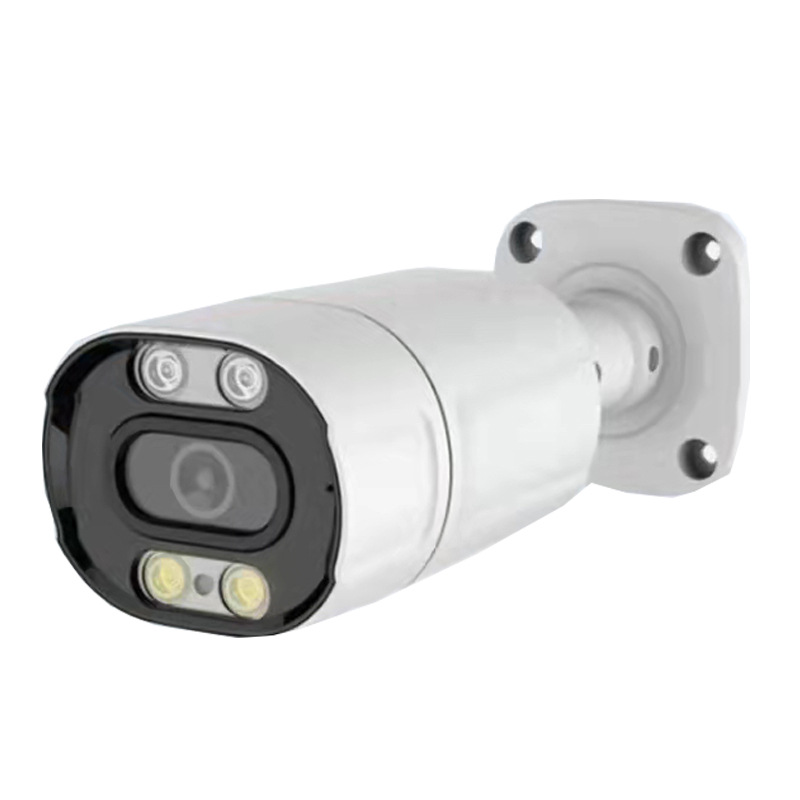
Hardware alone cannot overcome real-world lighting complexity—smart optimization closes the gap. Wide Dynamic Range (WDR) captures multiple exposures in a single frame, merging them to balance extreme contrasts—such as a dark parking lot entrance against a brightly lit lobby—without clipping highlights or burying shadows. Modern AI-powered noise reduction analyzes each pixel in real time, preserving texture and edges while suppressing grain—eliminating the smearing and motion artifacts common in legacy denoisers. Dual illuminators add adaptive intelligence: IR LEDs engage for silent, covert monitoring, while warm-white LEDs activate on motion or alarm triggers to deliver full-color verification—ensuring every frame supports actionable decision-making, not just marginal visibility.
FAQ Section
What causes grainy images in low-light surveillance cameras?
Grainy images occur when signal amplification compensates for insufficient ambient light, introducing visible noise that obscures critical forensic details.
How can motion blur in low-light conditions be reduced?
Motion blur can be reduced by optimizing shutter speed and relying on high-sensitivity sensors with effective noise reduction to maintain clarity in moving subjects.
What are the advantages of starlight sensors over traditional technologies?
Starlight sensors amplify minimal ambient light through larger apertures and back-illuminated CMOS technology, providing color fidelity and low-grain images in near-dark conditions.
Are IR cameras effective for low-light surveillance?
IR cameras are effective in pitch-black environments but may suffer from motion blur and reflective interference, making them less ideal for scenarios requiring high identification accuracy.
What is Wide Dynamic Range (WDR), and why is it important?
WDR balances lighting contrasts by merging multiple exposures within a frame, ensuring visibility in extreme conditions such as bright and dark areas in the same scene.
Table of Contents
- Why Low Light Surveillance Camera Performance Falls Short in Real-World Environments
- Night Vision Technologies Compared: IR, Color Night Vision, and Starlight Sensors
- Key Technical Specifications That Predict Low Light Surveillance Camera Effectiveness
- Smart Optimization Features: WDR, AI Noise Reduction, and Dual Illuminators That Actually Work
-
FAQ Section
- What causes grainy images in low-light surveillance cameras?
- How can motion blur in low-light conditions be reduced?
- What are the advantages of starlight sensors over traditional technologies?
- Are IR cameras effective for low-light surveillance?
- What is Wide Dynamic Range (WDR), and why is it important?